Confessions of a Recovering Code Rockstar
Moving from developer to manager means stopping execution to empower your team. Delegate early, guide the strategy, and build the people who build software.
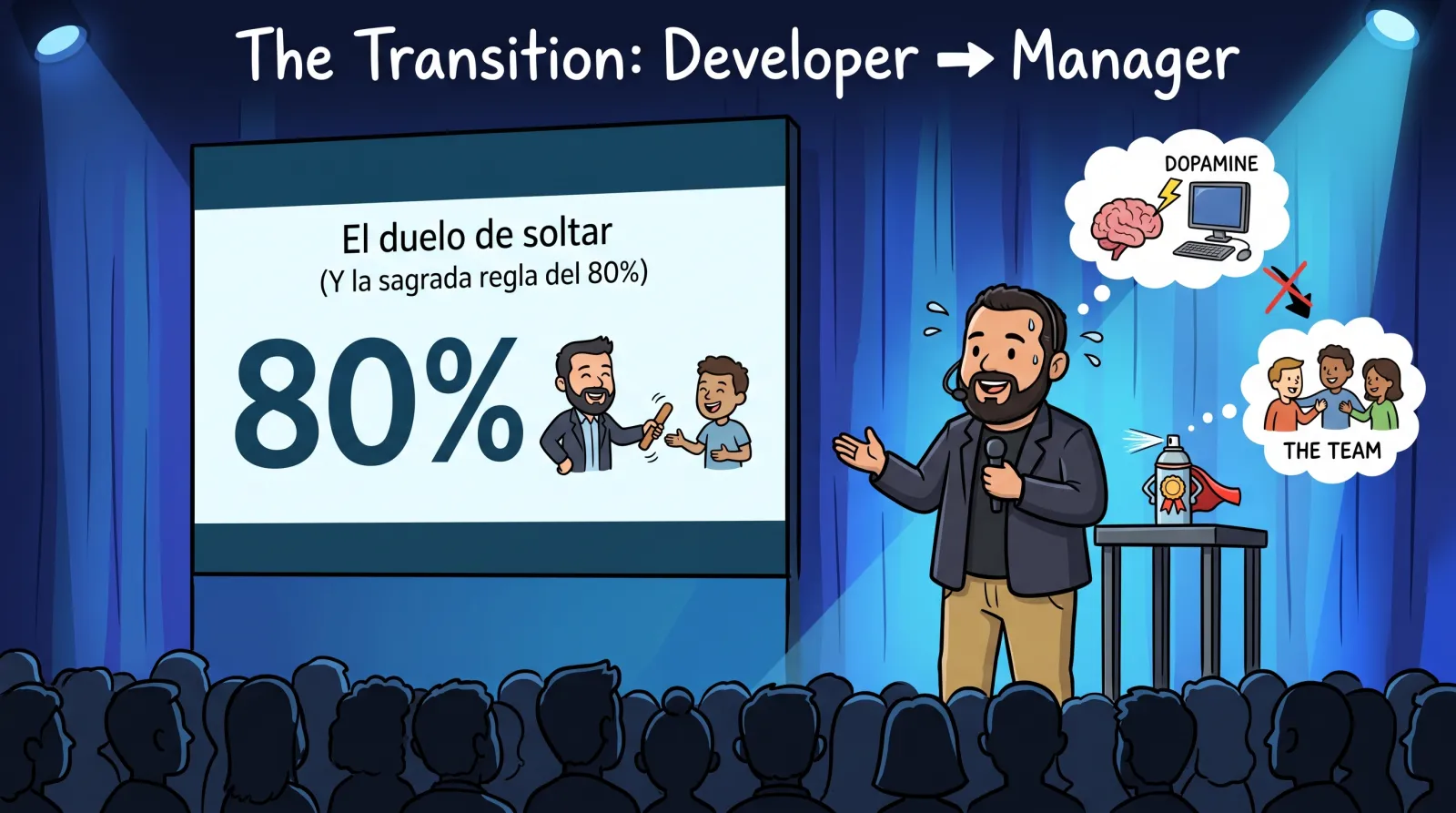
Confessions of a Recovering Coder
It has been six months since I stood in front of roughly 1,000 people at Talent Land. Looking back at that day, two things remain absolutely true: the transition from Individual Contributor to Manager provides enough material for years of therapy, and my deodorant truly deserves an award. 😅
Aside from a couple of technical glitches and my constant sweating on that stage, the talk went pretty well. At least nobody threw things at me, and I’m super grateful to everyone who showed up and had the decency not to fall asleep. But beyond the stage fright, the message I shared that day is something I’ve lived, breathed, and stumbled through during my wild ride into management.
When you make the jump from Developer to Manager, the corporate world plays a bizarre joke on you: you are rewarded for being a brilliant executor by being told to stop executing. You win the pie-eating contest, and your prize is managing the bakery. 🥧
If you are currently navigating this transition, or struggling to let go of your code, here is the survival guide I shared on that stage—and the lessons I still remind myself of every Monday morning.
🧠 The Dopamine Trap The hardest part of stepping back isn't a lack of trust in your team; it's pure biology. As engineers, we are hardwired for daily dopamine hits. You write code, it compiles, tests pass, you close a Jira ticket, and you feel productive. Management, however, is an exercise in delayed gratification. Building a high-performing team takes months. It is incredibly easy to finish a Tuesday packed with alignment meetings, feel like you "didn't do anything real," and panic.
That panic is what makes you jump into a Zoom call, watch a junior developer type slowly, and aggressively think, "Move over, I can fix this in five minutes." But when you steal the keyboard, you burn yourself out, and worse, you rob your team of the opportunity to learn. You cannot be the hero if you want your team to know how to use the fire extinguisher.
📉 The Sacred 80% Rule To break this cycle, I had to adopt a new mindset: If someone on my team can do a task 80% as well as I could do it today, I have to delegate it.
The perfectionists reading this will hate that. But the truth is, that missing 20% is rarely a lack of quality. It is almost always just your personal style. It’s your naming conventions and your quirks. As long as the code is functional, secure, and scalable, we have to accept that a brilliant mind can solve a problem using a different path than ours. Different does not mean wrong.
🛠️ A Framework for Delegating (Without the Panic) Delegating doesn't mean abdicating. You don't just throw people to the wolves. To keep my sanity (and avoid production disasters), I use a three-step framework:
- Define the WHAT and the WHY: This is my job. I provide the business context and measurable goal. Not "optimize the database", but "we need to reduce endpoint response time to 500ms so Customer Success can close the month without timing out."
- Let them define the HOW: This is their job. If I dictate the exact architecture, I am just using them as a human keyboard. I have to give them space to propose the solution.
- Validate the Approach: Before anyone writes code, we do a quick technical check-in. We review the trade-offs of their design to prevent over-engineering. Validating the strategy before execution is the only way to sleep peacefully at night.
Of course, keep it practical. We don’t need a summit for every bug fix. A tiny task might just need a quick Slack message or a thumbs-up on a rough outline.
🚀 The Real Product My growth over these last two years hasn't been about writing better algorithms; it's been about redefining my metric for success. Unblocking technical dependencies is the work. Negotiating with Product to protect my team’s weekends is the work.
I no longer build software. I build the team that builds the software.